Showing posts with label Economics. Show all posts

Tuesday, April 9, 2013

Ayn Rand's Utopia


We all know that libertarians believe in drug legalization, the free market, free speech and freedom of religion.

But what everyone forgets is that libertarianism effectively prohibits pollution of any kind (air, water, noise, etc.). It doesn't just tax it or discourage it. It makes it virtually impossible.

Philosophers from Thomas Paine and William Godwin to Robert Nozick and Frederick Hayek have written much about libertarianism. But I'm going to quote Ayn Rand, as she is the modern face of libertarianism (and the woman for which Ron Paul named his son):

"The basic right of man is to live his life without being harmed by others. This implies the requirement to refrain from harming others as well, since all men share this most fundamental right."


Ayn Rand
This isn't just Rand's philosophy. This is the core tenet of libertarianism and laissez-faire capitalism. This is why libertarians are against taxing people to provide social programs. By using force to take someone's money, you are harming them and violating the "basic right of man".

However, modern Objectivists rarely point out that burning coal or pouring chemicals into a river causes harm to others in the same way that taxation does. And like taxation, pollution uses force to cause harm. According to the World Health Organization, air pollution from burning coal kills more than 1 million people every year, and causes physical harm and monetary harm (aka "theft") to many many more. In Rand's philosophy, pollution is the moral equivalent of robbery or rape.

So, what is the role of government when one individual (the owner of a coal plant) is causing harm to others against their will?

Modern "right-wing" politicians (aka "the Republican party") advocate that we should ignore these harms. The coal plant is providing electricity and creating jobs, and one could argue that this benefit outweighs the harm (to the society as a whole, if not to each individual). Despite what Paul Ryan and the Koch Brothers would like you to believe, this is not "free market capitalism". This is tyranny. This is what Ayn Rand calls "collectivism" -- the government using force to decide that the "needs" of the entire society are more important that the rights of any one individual.

Modern "left-wing" politicians (aka "the Democratic party") advocate that we should "regulate" these harms. This means using government force to reduce "excessive" pollution, and to tax the rest. If the scientists at the EPA decide that burning coal causes $100 worth of damage to every American, then left-wing politicians will levy a tax on coal burning equal to $100 per American. They could then turn around and give this money to each person that was harmed. However, more often, that money is used to pay for government programs that attempt to ameliorate that harm (e.g. health care) or reduce future harm (e.g. investment in "alternative" energy).

As with the Republican solution, the Democrat's solution is also "collectivism". It is the government using force to put the collective good ahead of individual rights.

Libertarianism holds that both the Republicans and Democrats are allowing (and even encouraging) a moral wrong. No one has a right to harm any other person without using the free market to reach an agreement beforehand. I can't just burn down your house because I feel like it, and then pay you $100 the next day because I feel that this is the "fair value" of your home. If you want to sell me your house, you are free to do so. But we must come to an agreement *before* I burn down your house.

In the case of pollution, this means that every single person harmed by pollution must agree to it beforehand. As one individual, I could decide that I'm willing to let a coal plant pollute my air if they pay me $100 each year. Every single person could reach this same agreement with the coal company. This is the free market at work: individuals determining how much something (such as clean air) is worth *before* they sell it.

It's even possible that everyone would come together and legally delegate a representative to negotiate on their behalf. This is what unions do, and it allows the workers to continue to do their jobs and live their lives while a fair market price is determined.

However, unions are voluntary organizations. If you don't want to work for GM, you don't have to. But breathing isn't voluntary. If you pollute my air, you are using force to harm me, and it is the legitimate role of any libertarian government to stop that harm (by using the courts and police force to physically prevent this harm from taking place).

As it is virtually impossible that 7 billion humans will all agree to have their air polluted, libertarianism and pollution are incompatible in the real world (unless the polluter finds a way to contain the pollution in a bubble built on private land, or to stop the pollution at the source -- but then it isn't really "pollution", is it?)

At this point, libertarians might choose to compromise their principles in exchange for efficiency. For example, I would like to be able to drive a gasoline-powered vehicle so that I can visit my family on Thanksgiving. Therefore, I elect a government that enforces my "right" to pollute, even though I am violating the rights of others. This is democracy. But it isn't libertarianism.

Sunday, February 17, 2013

Dear Media, You Just Got Played


"Journalism is printing what someone else does not want printed: everything else is public relations."
          - George Orwell

Last week, Maker's Mark Whiskey announced that, because of such incredible demand for their product, they would be forced to add a "touch more water" to their 90 proof whiskey, lowering it's alcohol content from 45% (90 proof) to 42% (84 proof).

A week later, they claimed to abort this strategy because of overwhelming customer feedback. To quote the grandson of the company's founder: "We've been tremendously humbled over the last week or so. You spoke. We listened."

Both stories were covered by everyone was from Fox News to USA Today to NPR.

I call bullshit.

You may notice the similarity of the coverage from each "news" outlet, as if they each just cut and paste from the same press release.

This is the message that Maker's Mark got out to hundreds of millions of consumers in the last 7 days, for free:

  1. Our product is of such high quality that our sales have far exceeded expectations.
  2. This surprising popularity means we will have trouble distilling our whiskey to the exacting standings we have used for 3 generations.
  3. Our customers care about quality. So much so that they demanded that we continue to produce the highest quality whiskey we can, no matter what it costs!
  4. We care. We listened to our customers. We will continue to meet your demands for great whiskey, even if it cuts into our bottom line. Because ... we ... care.

One question for Maker's Mark. If your product quality is so high that it sells itself, and demand grows much faster than your ability to keep pace with production, why do you continue to spend $25 million per year on advertising that artificially pumps up demand?

I'm sorry for bringing additional attention to this scam. But hopefully it will shed light on this story for what it really is -- yet another company playing the media like a fiddle.

I'm not a whiskey drinker. If I need to get drunk, Bud Light does the job. If I'm thirsty and need a glass of water, Bud Light does the job.

But if you are a whiskey consumer, please take a minute to go to your locally owned spirits shoppe and purchase something from a manufacturer that puts their money into their product, instead of pumping it into advertising and deceitful PR campaigns.

Monday, January 21, 2013

Mitt Romney's America


With the inauguration of Barack Obama to his 2nd term, it's worth taking a moment to consider what the United States would be like today if Mitt Romney were taking the oath of office on the Capitol steps.

It is, of course, difficult to know. Romney invented Obamacare before denouncing it. He said that government can't create jobs, but that his administration would create 12 million jobs. He is "staunchly pro-life" and "defends a woman's right to choose".

So, we have no idea what his policies would be. But we do one thing about the way he thinks everyone should live.

"If a Democrat were here, he'd look around and say no one should live like this. Republicans come here and say everyone should live like this." - Mitt Romney, during a fundraiser at "Papa" John Schnatter's 24,000 square foot limestone castle, complete with 22-car garage and private golf course.


Unlike the "47%" comment, I actually think Mitt is proud of this statement. With hard work, low taxes and generous government subsidies for the rich, we can all live like Papa John.

Wow.

I'm going to ignore the fact that Mr. Schatter's carbon footprint is bigger than Godzilla's, and just think about the actual logistics of everyone living like this.

In "Mitt Romney's America":

1. Everyone has a 22-car garage. We each get about 10 cars plus some empty spaces for visitors.

2. Everyone has 11 bathrooms. Because everyone like this, you can't hire someone to clean your bathrooms for you. They are too busy cleaning their own bathrooms. And do you really expect someone with their own private golf course to spend their days cleaning toilets?

3. Everyone repairs air conditioners. Again, you can't hire an HVAC specialist for a reasonable rate, because they are all busy keeping their own homes running. Perhaps some sort of barter economy would develop where your neighbor would clean and maintain your cooling and heating systems in return for you cleaning and maintaining her four swimming pools. Or maybe you'd rather spend 120 hours each week washing dishes or vacuuming walk-in closets.

4. There are no schools. Everyone is too busy mowing lawns for anyone to go to college and become a teacher. Also, kids have to start work as soon as they can operate a pair of pruning shears.

5. There are no cities. Everyone lives on 16 acres. The sprawl created by everyone moving out of New York City would cover 400,000 square miles, stretching from Canada to Florida (and completely covering Maine, New Hampshire, Massachusetts, Rhode Island, Connecticut, New York, Pennsylvania, New Jersey, Maryland, Virginia, West Virginia, North Carolina, South Carolina and Georgia).


6. After filling every square inch of the United States (including Alaska) we would invade and colonize: Canada, Mexico, India, China, Brazil, South Africa, Kenya, Greenland, Saudi Arabia, Iran, Argentina, Indonesia, Pakistan, Nigeria, Japan, Vietnam, Egypt, North Korea, South Korea, Bangladesh ... and all of Europe. This kills or displaces more than two thirds of the world's population.

Alternatively, we could occupy every acre on the Moon and still have enough Americans to fill all of Siberia.

7. There are no universities, no telephones and no internet. We have giant unlit houses with no roads and no electricity running to them. There are no hospitals or research laboratories. America would become the least innovative country on the planet (behind Burundi and Mozambique).

8. On the bright side, we would have the world's lowest wealth inequality (better than Sweden and South Korea).

Oops. I just noticed that Mitt didn't say "every American". He said "everyone".

So, new plan. First, pave over every ocean and lake so that the Earth has enough land for all the people in China, India and Brazil. The United States gets all of the moon, and most of Mercury (the new "Sunbelt"). Russia gets Mars (they like cold weather). Everyone else fits on Venus. And Neil deGrasse Tyson can go live on Pluto.

Friday, January 4, 2013

The Poor Get Screwed ... Again

This post should be short, as the graph speaks for itself.

Congress just passed, and Obama just signed, the "American Taxpayer Relief Act of 2012" (aka "ATRA").

Since Obama won the election, we know that ATRA shifted the federal tax burden from working people towards the top 2%. Right?

Wrong.

The percentage increase, by household income group, of federal tax burden, from last year to this year:


As expected, everyone's taxes went up. But the poor got hit with a 120.9% tax hike.

Before the comment section fills up, I do realize that those earning $500,000 pay more taxes in terms of absolute value than someone earning $20,000. (In fact, I used to be a Republican).

For example, a family earning $20,000 that had a $2,000 federal tax bill could see their taxes go up to $4,418 -- an increase of $2,418.

Meanwhile, a young stock trader making $500,000 on Wall Street might see his federal taxes go from $75,000 to $77,850 -- an increase of $2,850.

$2,850 is bigger than $2,418. Therefore, Congress is soaking the rich! Your logic is impeccable. Now go fuck yourself.

Seriously, which family can better absorb a big tax hike?

As the poor already pay much more in taxes as a share of their income, this is horrible news for those families hit hardest by the recession.

Mitt Romney famously said: "I'm not concerned about the very poor."

It appears that Obama and Congress feel the same way.

Source: Tax Policy Center

Tuesday, November 27, 2012

Marvin Miller Dies at 95

Marvin Miller (1917-2012)

Marvin Miller, the father of free agency in baseball, died today at the age of 95. For those unfamiliar with baseball's labor history, I'm including below the history of baseball labor relations that we published 7 years ago (with some updates as part of our efforts to provide more realistic historical labor relations in Baseball Mogul 2014).

19th Century: The "Reserve Clause"

Although baseball rapidly evolved in the 19th century, its labor practices remained arcane. The owners were clever financial manipulators who championed the myth of baseball to establish the game in a way which also enriched their bank accounts. The first professional baseball league, the National Association of Professional Ball Players, formed in 1871. With little organizational structure, players jumped from team to team each year, campaigning for the best offer. The Association folded five years later in 1875. In 1876, a coal baron named William A. Hulbert, determined to ensure control resided with the owners, and not the players, founded the National League of Professional Base Ball Clubs.

Albert SpaldingWilliam Hulbert
To prevent the chaotic team-switching that had plagued the previous association, the teams agreed to secretly "reserve" five players at the end of each season. By the early 1880's, however, the Reserve Clause officially came into existence. The clause stated that the club had the right to renew a player's contract following each season - effectively making the player's contract the property of the team that first acquired him for the rest of the player's life. While the contract, and thus the player could be traded, a player could not choose to play for another team or effectively campaign for a salary raise. A powerful new owner, Albert G. Spalding, emerged during this time period. Complaining that baseball was facing a disastrous decline, Spalding decided to establish baseball's first salary cap at $2,500 a year.

1889: The First Player's Union

In response to this and the unpopular reserve clause, John M. Ward, a Columbia law school grad, organized baseball's first union, the Brotherhood of Professional Baseball Players. In its manifesto, Ward wrote that "players had been bought, sold, and traded as though they were sheep instead of American citizens. Like a fugitive slave law, the reserve clause denies him a harbor and a livelihood, and carries him back, bound and shackled, to the club from which he attempted to escape." Showing what would prove to be the usual degree of respect accorded baseball unions, Spalding and the rest of the owners responded by demanding the player's pay rent for their uniforms. Unwilling to be so disgraced, the players decided to form their own league.

The player's league, however, fell victim to a crowded market and the constant public pressures of the National League owners. Attendance dipped, and the league folded. After successfully destroying the league and the brotherhood, Spalding used all the rhetoric of baseball lore to describe the league's fate: "When the spring comes and the grass is green upon the last resting place of anarchy, the national agreement will rise again in all its weight, and restore to America in all its purity -- its national pastime -- the great game of baseball". Complete with the language of baseball as American, historic, pure, and pastoral, Spalding added another symbol to the mix - that of the national agreement. Without actually defining it, Spalding referred to "the national agreement" as the player's acceptance of the reserve clause. This “agreement” would prove to last almost one hundred years.

1922: Baltimore Terrapins lose to National League in Supreme Court

The national agreement would continue relatively un-assailed until the early 1920s, when a baseball team from Baltimore sued the National League over what it saw as monopolistic practices - included, but not limited to, the reserve clause. The case, Federal Baseball Club of Baltimore, Inc. v. National League of Professional Baseball Clubs, reached the Supreme Court in 1922. Although the Baltimore lawyers demonstrated several monopolistic practices prohibited by the Sherman Anti-Trust act, a unanimous Supreme Court ruled in favor of the National League. Chief Justice Oliver Wendell Holmes wrote in the court's opinion that baseball failed to meet the definition of interstate commerce. Calling the transport of players across state lines "mere incident" to the business conducted at the individual ball parks, Holmes and the court found a shaky and peculiar loophole for baseball's antitrust exemption, a practice the Supreme Court would continue for the next half century.

1946: Danny Gardella

Around mid-century another pair of cases challenged the legality of the reserve clause. The first, in 1946, involved Danny Gardella, who had turned down a contract with the New York Giants in order to play in the newly formed Mexican League. When the Mexican League failed shortly thereafter, Major League owners quickly punished those that had "defected”, threatening "America's Game". The clubs blacklisted each of the defectors for five years (although they did grant some exceptions). Gardella, who had never signed a contract in the majors, seemed to have the best case against the league, and he filed suit shortly thereafter. The owners, detecting an affront to the purity of the game, attacked Gardella in the press. In the typically exaggerated rhetoric owners would dip into when the game, and their pocketbooks, were threatened, Branch Rickey of the Dodgers proclaimed Gardella's attempt at free labor to possess a "communistic tendency". Few phrases could resonate louder in America with the Cold War just starting to heat up.

1953: George Toolson

Shortly thereafter, George Toolson brought another suit against baseball's reserve system. Toolson, who had toiled in the Yankee farm system for years, believed the reserve clause kept him from catching on with another team and making the majors. In 1953, Toolson v. New York Yankees reached the Supreme Court. The court, despite radio and television now sending games all over the country, maintained that baseball did not constitute interstate commerce. In rejecting Toolson's appeal, although not unanimously, the court shifted the burden to Congress to overturn baseball's antitrust legislation.

1966: Marvin Miller

The baseball plantation system carried on unperturbed. Despite the game's growing popularity and enormous new income from radio and television rights, the average player salary stayed at almost exactly the same point - compared to the general population - as it had for a century. In 1966, Dodger pitching stars Sandy Koufax and Don Drysdale decided they could obtain a more representative amount of money if they negotiated together, and with agents. The owners were shocked. Dodger owner Walter O'Malley summed up the owners' view. "Baseball," he stated, "is an old fashioned game with old fashioned traditions". The duo later signed, without agents, for a salary several times lower than they had demanded.

Later frustrated by the owners' failure to place the specified amount of money in the pension plan, player sentiments for a strong union grew rapidly. In 1966, the players decided that the union needed a strong leader. After the first candidate fell through, the players named Marvin Miller, Chief Economic Advisor to the United Steelworkers of America, the first executive director of the Players' Association. The owners, of course, were angered, but the players had finally found a battle-tested leader in their fight against the reserve clause. "The moment we found out that the owners didn't want Marvin Miller," Flood stated. "He was our guy". The task for the players, however, still loomed large.

The myth of baseball, at least the version peddled by the owners through the newspapers, seemed almost invincible. If a player refused to cooperate with the team or seeked greater pay, he challenged not the owners personally, but "the Good of the Game". The players' dilemma proved great. The owners had spun the myths of baseball pastoral purity into Spalding's great "national agreement". A player privileged enough to play baseball had the duty to protect the "integrity" of the game, even if it meant accepting a reserve clause and a lower salary. "What burns me", Curt Flood wrote, "is the awareness that certain of his contributions to the fables of baseball strengthen the employer's position and weaken his own". Even with Miller at the union's helm, in the mid-1960s baseball seemed just as unassailable as it had a century earlier. A headline in the April 1964 edition of "Ebony" magazine read "Wanted: Abe Lincoln of baseball." Yet until the end of the decade, no player had stepped to the forefront, and the "national agreement" remained largely un-debated.

Curt Flood (1967) Curt Flood (1971)

1970: Curt Flood

On January 16, 1970, Curt Flood shocked the baseball world and America by filing suit against Major League Baseball and its reserve clause. Baseball had faced legal challenges in the past, but never had a player of Flood's caliber attempted to assail the game's sacred clause. The St. Louis Cardinals outfielder had earned three All-Star appearances, seven Gold Gloves, and a pair of World Series championships. Furthermore, Flood earned $90,000 a year, yet accused baseball of violating of the 13th amendment, barring slavery and involuntary servitude. With a few exceptions, the public and the media initially reacted to Flood's action in utter disbelief, branding the outfielder as an ungrateful "blasphemer".

Flood's case eventually climbed all the way to the Supreme Court. In the arguments, Flood's lawyer, former Supreme Court Justice Arthur Goldberg, put forth evidence that baseball's reserve clause violated the antitrust laws by depressing wages and limiting a player to one team. Baseball's defense lawyers countered Goldberg's broad arguments for human and labor rights point-by-point, but the crux of baseball's argument dealt with such ideas as tradition and "The Good of the Game." Through the course of the case, Flood gained more of the public's sympathy as the truly antiquarian nature of the reserve clause became known. The remarkable thing was that Flood lost the case. The Supreme Court ruled in favor of baseball 5-3, not on the strength of their case, but on a strange line of thought that combined a liberal use of stare decisis with a belief that baseball simply should stay the way it is.

The End of the “National Agreement”

Despite suits of a few no-name players like Gardella and Toolson and the contract protests of a couple of baseball's highest stars, the reserve system and Spalding's "national agreement" had remained firmly in place for almost a century. Despite sporadic protests, the system was designed so that, as Flood stated, "When truth challenges mythology, a wise ball player keeps his mouth shut". When Flood brought his suit in 1970, his greatest challenge, if not a Supreme Court neck-deep in baseball lore, stood as the American baseball fan with little time for the claims of a "$90,000-a-year slave." Flood later reflected on this: "It was so difficult for the fans to understand my problems with baseball. I was telling my story to deaf ears, because I was telling my story to a person who would give their first-born child to be doing what I was doing". In order for Flood to break the deal that had bound the owners, players, and American public for almost a hundred years, he had to debunk the most powerful of baseball myths and establish the baseball player as an example of the American working man.

As Flood realized, for his cause to even hold a chance, baseball could not be seen as high, holy, and sacred; it must be brought back down to real life, where he always had felt it correctly belonged. Flood attacked baseball myths, and through them the baseball establishment, in several ways. In order to improve his own "corner of society," he must first destroy some of baseball and America's most sacred myths. Through showing baseball's antiquarian ways and prominent racism, he crafted a picture of baseball as the refuge from little but common sense. Like civil rights leaders of the early sixties, Flood sought no revolutionary change but more a fulfillment of the values that America had so long supposedly championed.

The Court of Public Opinion

In his attempt to bring baseball down from myth to reality, Flood turned to one of the classic methods for ending illusions. He described the baseball player's life in complete and vivid detail. How long, he must have wondered, could the purity of the game endure after his descriptions of a life of wild nights, drugs, and sleazy women? Flood vividly described the daily drug intake needed to fuel a player through the long season and the matter-of-fact sexual arrangements made with the myriad baseball groupies in every city on the road. "The baseball establishment is permissive about revelry," Flood wrote, and suddenly the game did not seem quite so pure.

Flood similarly attempted to ground baseball in the rhetoric of the working man. Players were not gods patrolling the lush, pastoral fields but just men striving for security and stability. Flood variously described the ballplayer as "a consignment of goods," "poultry," "chattel," and "a car". He wrote that "baseball's terminology betrays its essential attitudes, which are those of animal husbandry. Baseball regards us as sheep". In choosing "sheep," the exact word choice of Ward in his 19th century critique of the reserve clause, Flood illustrated how little baseball players had progressed in a century where labor reforms had swept the nation. As Flood took one more swing at baseball and its pedestal, the "national agreement" stood on its last leg. As Flood's case hurtled toward the Supreme Court, he neared the close of what Miller called an "assault on the handful of words that had held baseball players in bondage for a century". And although the Supreme Court would side with the baseball owners, Flood had set the stage. Even in Flood's defeat, baseball would never be the same. The Court made clear it had only freed baseball on a technicality and urged congress to take action. Although some of the owners celebrated, most realized a defeat for Flood only slightly postponed the inevitable. The reserve clause, although still in existence, had little life left. Even the conservative commissioner Kuhn remarked that "change was in the wind".

1975: Andy Messersmith and Dave McNally

Despite promises to debate and modify the reserve clause after the Flood case, the owners, as always behind the time, decided to sit on the reserve clause for a few more years. In 1975, Andy Messersmith and Dave McNally filed grievances against the reserve clause. The case eventually reached arbitration and Peter Seitz. With Flood's arguments now well established and much more accepted throughout America, Seitz ruled in favor of the players and against baseball - stating that the reserve clause only kept players with their team for one year. The reserve clause's reign had ended.

Today

Since the origins of professional baseball until 1976, player salaries hovered around eight times that of the average American working man. By 1994, baseball players on average made 50 times the average worker. In 2003, the mean salary stands at over one million dollars. Near the end of Flood's life, when salaries soared into amazingly high numbers, he stated that today's players were finally receiving what the players of his day had deserved.

Wednesday, November 7, 2012

Middle-Aged White Man Denounces GOP


Dear Republican Party,

Allow me to introduce myself:

1) I am a white male. I am over 40 years of age. My family is white. My wife is so white that she has solar urticaria. She is literally allergic to sunlight.

2) I love America, the best country on earth. I am extremely patriotic and I strongly support our men and women in uniforms. My parents met in the Air Force -- I literally wouldn't be here without our armed forces. My company gives away all of our products, for free, to active members of the military.

3) I revere the Constitution. Our founding document is so brilliant that it hints at divine inspiration.

4) I can trace my family line in the New World back to 1630. My great great great great great great grandfather was a Revolutionary war hero.

5) I am pissed off at the current immigration situation. I work hard and pay my taxes while illegal immigrants and their employers get off scot-free.

6) I believe that the Federal government is way too big and that government bureaucracy is one of the greatest threats to our economy and to our freedom.

7) I am a business owner and job creator. Because our product is internationally popular, more than 60% of our revenue over the last two years came from overseas. In other words, I am doing my part to fix the trade imbalance and create American jobs.

8) I voted for George W. Bush and John McCain.

9) I am a workaholic. I haven't taken a real vacation since 1998. At the age of 14, I spent the summer literally "breaking rocks in the hot sun" for $4.00 an hour.

10) I believe in self-sufficiency and abhor debt. When I was laid off, I didn't collect unemployment insurance, because we didn't need it. Even though I have a disability that prevents me from working most jobs, I have never applied for benefits. My wife and I have no debt and we paid off a 30-year mortgage in less than 8 years.

Based on the above, you know that I voted for Mitt Romney yesterday. Right?

Wrong.

Here's why:

1. Fiscal Irresponsibility
I grew up learning that the GOP excelled at fiscal responsibility and economic growth. Roosevelt cranked up the national debt (from below 25% of GDP, to more than 100%) in order to pay for Social Security and World War II. Then Eisenhower was elected in 1952 and he brought the debt from 60% of GDP down to 45% over the next 8 years.

Lyndon Johnson didn't significantly increase the debt, but he did create two huge government programs (Medicaid and Medicare) and escalate the War in Vietnam. By the time President Nixon left office, the debt had reached its lowest point since the Great Depression (just 23.9% of GDP).

Alas, the Republican Party since Richard Nixon has looked more like the Bizarro Republican Party. And these failures by the GOP over the last 40 years cannot be blamed on external events or on Democrats in congress. They are a direct result of Republican policy.

Between the Bush Tax Cuts (a huge handout to the rich), Medicare Part D (a huge handout to pharmaceutical companies) and the War in Iraq (a huge handout to private defense contractors), George W. Bush added more than $7 trillion to the national debt.

By comparison, the Democrats have looked like Scrooge McDuck, pinching pennies and lowering the deficit. Clinton ended welfare as we knew it and turned Reagan's huge budget deficit into an actual budget surplus. Even Obama the "socialist" has reduced the deficit by over 3% of GDP in the last three years. This is more than in any 3-year period since the early 1950s.

2. Your Hatred Of The Free Market
Our government is giving more than $78 billion to oil companies over the next 10 years. That's more than $8,000 out of my family's pocket. Obama tried to end these subsidies, but he was voted down by 51 senators. Forty-seven of these senators were Republicans.

In 2005, Dick Cheney and Republicans in congress exempted Halliburton and other natural gas drillers from regulation under the Safe Drinking Water Act. If I compost broccoli stems in my backyard, I have to comply with the SDWA -- but Halliburton doesn't.

These examples are just the tip of the iceberg. This isn't the free market. This is the antithesis of the free market. This is the government taking tax dollars from my pocket and giving them to rich people.

3. "Job Creators"
John Boehner is either an idiot or a liar. He describes those benefiting from the Bush tax cuts as "job creators" and claims that raising their taxes will cripple our economy. This is not only specious, it is the opposite of the truth. Increasing top marginal tax rates increases the incentive for business owners to hire more people and reinvest in their company, because such investments are entirely tax-deductible.

All evidence from the last 70 years shows that the economy does much better when we at least try (with high marginal tax rates) to get the rich to pay their fair share of taxes. This is because the rich do not create jobs. Small businesses do. According to ADP, small businesses (with fewer than 50 employees) created 5.5 million new jobs between 2001 and 2007. Large businesses (with 500 or more employees) actually eliminated more than 600,000 jobs during the same time period.

Virtually all small business owners earn less than $250,000 per year. Unlike Sam Walton and the Koch brothers, small businesses can't use political power to get giant handouts from the government. Instead, I pay more than my fair share of taxes while creating American jobs. If every American earning more than $250,000 had the same trade surplus that I do, we would have a national trade surplus of more than $1.3 trillion (instead of our current trade deficit of about $550 billion).

The next time you see a small business succeed, remember: I built that! John Boehner and Paul Ryan didn't build it. And the Republican party certainly didn't build it.

4. National Defense
The Iraq War wasted trillions of dollars, killed 4,487 American soldiers and injured almost 32,000 more. It also made us less safe: "Al Qaeda In Iraq" didn't exist before we invaded.

Barack Obama issued the order to kill Osama Bin Laden. Mitt Romney said it wasn't worth the effort to "catch one person".

5. Integrity
My breakup with the GOP started that day in 2003 when President Bush lied to me about WMDs in Iraq.

President Clinton lied about oral sex. President Bush lied to get us into an unnecessary war that killed more than 4,400 American soldiers and over 100,000 civilians. Both of those lies were wrong. One of those lies was evil.

6. Wealth Redistribution
I paid over $200,000 in taxes last year. And yet my wife volunteers at food pantries so that American children won't go hungry. We have had to give money to friends to keep them from becoming homeless. Meanwhile, the Koch brothers are busy trying to steal more than $10.6 billion each year from middle class taxpayers.

The GOP complains that wealth is being "redistributed" from the rich class to the poor. The truth is that the Federal government primarily redistributes wealth from the middle class (actual job creators) to the rich. Democrats like Obama and Biden realize this, and are making an honest effort to reverse this ruinous trend. If we continue transferring wealth from the middle class to the super-rich, we will have the same income inequality as Brazil in just 6 years.

If you don't know why having the same Gini coefficicent as Brazil would be a bad thing, you need to spend more time reading international news and less time reading Ayn Rand.

-------

Take note that I didn't mention Obamacare, abortion, climate change, racism, gender discrimination, gay marriage or other "social issues". I haven't abandoned the GOP because the GOP hates gays. I have abandoned the GOP because you no longer stand for the things that you say that you stand for.

National politics in my lifetime can be easily summarized. The GOP espouses a set of beliefs that are important to the American people such as: integrity; self-reliance; fiscal responsibility; economic opportunity; rewarding hard work; protecting families; securing our borders; and maintaining a strong defense. Then, when we elect Republicans to advance these ideals, you fail on every count and we have to wait for a Democrat like Bill Clinton or Barack Obama to actually govern according to these principles.

I can no longer call myself a "Republican" when that label has come to mean "rich white guy pillaging the middle class for personal gain".

Monday, February 13, 2012

Obama's New Budget Doesn't Add Up


I don't understand the math for the Department of Education in Obama's new budget.

First, we have a new $8 billion program to get community colleges to actually train people for jobs that are going unfilled.

Second, we have a reduction of college loan interest rates from 6.8% to 3.4%. According to House Education and Workforce Committee Ranking Member George Mille (D-CA) and Rep. Ruben Hinojosa (D-TX), this will give 
more than $2,800 per year to about 7 million undergraduates.

Seven million times $2.800 is about $17.6 billion.

Finally, there's the $2,500 "partly refundable" tax credit for college education. There are about 21 million students currently enrolled in college programs that would qualify for this credit. This tax credit is aimed at "low income families", which the government defines as families earning less than $160,000. Wow. That's almost 4 times the median household income, and includes some families in the top 5% of household income. That's what happens when you let millionaires write the laws: they decide that someone earning $80 an hour is "low income".

Anyway, let's be conservative and assume that only 80% of those 21 million qualify for the credit. That's another $42 billion.

Forty-two billion plus $17.6 billion plus $8 billion is $67.6 billion.

But the article says that the Dept. Of Education budget is only going up by 2.4% (to $69.8 billion).

So there are $67.6 billion in new programs squeezed into a $1.6 billion budget increase?

Which means these proposed expenditures are hiding somewhere else in the budget...


Sunday, June 12, 2011

We Are The 53%!

Photo by Gage Skidmore
Michelle Bachmann (R-MN) pointed out yesterday that 47% of Americans pay no taxes. In her defense, I think she meant to say that 47% of U.S. households don't pay federal income taxes. Nevertheless, income taxes are the biggest part of my yearly tax bill, so it seems that she has a point. As someone in the 53% that actually does pay income taxes, I'd like to know how our income tax system lets 47% of us get by paying nothing.

Here are the income tax rates, by income category, provided by the Congressional Budget Office:


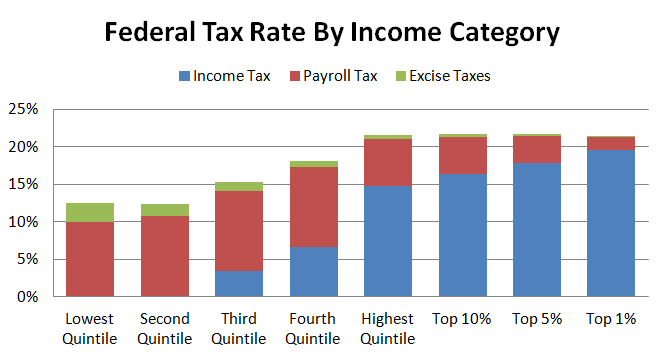
Representative Bachmann is right. There are about 140 million Americans on the left side of the graph that aren't paying any taxes. But income taxes aren't the only federal taxes. Almost $900 billion in annual revenue is collected through payroll taxes on each and every paycheck. Another $75 billion is collected in excise taxes, such as those on gasoline. When we add these things in, things become a bit more equal.


However, it's clear that federal taxes still fall disproportionately on the top 20%.

Unfortunately, those aren't the only taxes we pay. More than 40% of our yearly tax bill goes to state and local governments, mostly in the form of sales and property taxes.


When we add together all taxes, we see that "the poor" (the bottom 20%) are the ones paying the highest tax rate.

Wow. This is hard to believe. But the more you think about it, the more it makes sense. The working poor spend the highest share of their income on basic necessities like housing and transportation. This is where property and sales taxes hit the hardest.

When I started researching this, I honestly thought that I would find out that the richest Americans were paying the highest tax rates. After all, we are constantly told that our tax system is progressive, meaning that tax rates rise as income levels rise.

As it turns out, the U.S. tax system isn't progressive. Of all the groups above, the top 1% actually have the 2nd lowest tax rate. The poorest Americans have a tax rate that is 38% higher than the rate paid by the richest Americans.

Wow.

So, the next time someone tells you that 47% of Americans don't pay any taxes, show them this graph:


Sources:
Historical Effective Tax Rates: 1979-2006. Congressional Budget Office.
Additional Data on Sources of Income and High-Income Households. Congressional Budget Office.