Saturday, January 14, 2012

The NFL's "Worst" Pass Defenses

In tonight's 45-7 drubbing of the Broncos by the Patriots, I have to admit that the 2nd half was pretty boring.

Here's what I did see that was interesting:

CBS put up a graphic showing that the best teams in the NFL this year also had the worst pass defenses. This wasn't the first time I had seen this stat trotted out as "proof" that the Packers, Saints and Pats have horrible pass defenses.

Team
WonLostPass Yards
Allowed Per Game
NFL Rank
Green Bay Packers
151301.2 32nd 
New England Patriots
133283.0 31st
New Orleans Saints
115266.7 30th

Well ... duh.

Teams that win most of their games are often playing with the lead. That means that their opponents are playing from behind. Teams trying to catch up have to pass more. And teams that pass more get more pass yards.

Furthermore, these three teams have the three best QBs in the NFL. With Brady, Brees and Rodgers leading your passing attack, it doesn't take very long to score. And teams that pass use up less time on the clock. That gives opponents of these teams even more opportunity to rack up passing yards.

The problem with Passing Yards is that it's an absolute stat, not a rate stat. So circumstances that cause a team to pass more will make it look like they are "better" passing teams.

To show that good teams allow more passing yards, I took the free version of Football Mogul and created a universe where every team had the exact same players on defense. And then I used the "Simulator Tool" to simulate the 2011-2012 one hundred times, to look at the impact that a team's offense has on their passing yards allowed:

Team
WinsPass Yards Allowed Per Game
Great Teams
13 - 16259.7
Good Teams
10 - 12257.2
Average Teams
7 - 9244.3
Bad Teams
4 - 6240.1
Horrible Teams
0 - 3241.6

As you can see, the better teams allow more passing yards. Using passing yards allowed to measure a football defense is like using double plays to measure a baseball defense. Counterintuitively, bad teams turn more double plays, simply because they allow more base runners, and you need someone on base to turn a double play.

If the talking heads really wanted the truth, they would show this:

Team
WonLostOpponent Passer Rating NFL Rank
Green Bay Packers
15182.211th
New England Patriots
13384.716th
New Orleans Saints
11588.124th

Alas, saying that the Patriots have an "average passing defense" doesn't make for eye-catching on-screen graphics. So for now we'll have to continue to hear about New England's incompetent secondary.

Thursday, January 5, 2012

Decoding With A Twist

A puzzle I sent to a friend today. Thought it up while trying to get out of bed.


Friday, September 30, 2011

Cain's 999 Plan Is A Job Killer

As a small business owner, I just need to take a moment to talk about how horrible Herman Cain's "999" tax plan is.

"999" is catchy phrase that sounds simple. And since my business spends about $45,000 each year just complying with tax law (in order to literally stay out of jail), "simple" would be an improvement.

The problem is, "999" doesn't make my taxes simpler. It actually will cost me a lot more to calculate my taxes, appease the I.R.S., and stay out of jail. The third "9" in "999" is an entirely new national sales tax. Herman Cain wants 9% on top of everything I sell. And it's not a value-added tax, it's a straight sales tax. So, if I buy computer parts for $900 and then sell them computer for $1000, I owe the Cain Administration $90. That's 90% of my margin, before I even pay for other taxes or expenses.

The Christian Science Monitor reports that Cain's plan eliminates the ability to treat labor as a business expense. So let's imagine that my small company earns $500,000 making software, and spends $50,000 on capital (like computers) and $400,000 paying five employees. Under "999", I pay an all-new 9% sales tax on my $500,000 of sales. Then, because I can't deduct the $400,000 of labor cost, I pay a 9% corporate tax on that. As a small business owner, I have to declare corporate "profits" as personal income, so I pay another 9% on the $450,000 that I didn't spend on capital equipment. Finally, my employees have to pay a 9% income tax on the $400,000 that I pay them. And when they spend that $400,000, they pay another 9% for the new national sales tax. So, Cain's "999" plan has added $189,000 in brand new taxes for a company that only sells $500,000 worth of stuff. And all those taxes are in addition to all my other taxes like property taxes, local business taxes, excise taxes and state sales taxes. Herman Cain has single-handedly turned a profitable small business with five employees into a money-losing business; one that will shut its doors and fire everyone within the first year of his presidency.

"999" is a great plan if you want to shut down every small business and force those employees to go work for large corporations or the government. It's the end of small business, and the end of innovation. It's the fastest way I can think of to turn American into a Third World Nation.

Furthermore, "999" is a lie. Rich Lowrie, Cain's Senior Economic Advisor, says that the "this is an attempt to shift the tax burden away from production and towards consumption, to balance the load. This taxes everything once but nothing twice.” As you can see above, if I earn $1,000 in revenue by selling a computer, that $1,000 is taxed multiple times before it ends up in the hands of my employees. And thanks to an all-new national sales tax, that money is taxed again when they spend it.

And the idea that this shifts taxes "away from production and towards consumption" is bullshit. Labor (paying someone to "produce" something) is now taxed three times. But buying capital equipment (consumption) is only taxed once.

As for the national sales tax, once you add another tax, it never goes away. The average American currently loses 44% of their paycheck to taxes. Just using back of the envelope math, it would appear that Mr. Cain's '999' plan would reduce this tax burden to about 27% (9% + 9% + 9%). But he isn't actually reducing taxes. That 44% figure includes property taxes, state income taxes, gasoline taxes, excise taxes, state sales taxes, etc. When all is said and done, it's likely that an average American, earning about $40K per year, will end up losing more than 50% of that to taxes under Cain's plan.

So, he wants to increase taxes on the middle class, and further decrease taxes on the wealthy. In other words, he wants to continue down the path we've been following for the last 30 years of taxing the middle class and transferring it to the top 1%. And in the process, it doesn't simplify the system. In fact, for small business owners like myself, he makes it significantly more complicated, and more costly, to comply with -- something that will undoubtedly lead to more layoffs and more unemployment.

Thursday, August 18, 2011

Honesty


I feel a bit weird talking to a Customer Support person, whom I'm pretty sure is India, but wants me to call him 'Aaron'.

Why does FedEx (and every other company that outsources their phone banks to India) think it's necessary to pretend that I'm talking to someone in Texas?

My experience so far is that the overseas customer support folks are as nice, as knowledgeable, and as well educated as the ones I used to talk to in the U.S.

It makes sense that this would be the case. In the United States, phone support pays worse than fast food. But in India, they've probably got college graduates answering the phones.

My problem is just that I don't like being lied to. My computer monitor was made in China. It's outlandishly affordable and of pretty high quality. So I'm not complaining. So if U.S. companies aren't lying to me about where my computer is manufactured, why do they have to lie to me about who I'm talking to on the phone?

Friday, July 29, 2011

Obama's "Failed Stimulus"

I'm getting sick and tired of everyone referring to Obama's "failed stimulus".

But what really bugs me is that almost no one is bothering to point out that the stimulus actually prevented the Second Great Depression.

The vast majority of economists agree that the economy needed stimulus, funded by deficit-spending.

And they were right.

(In looking at that graph, note that Obama signed the 'Recovery Act' in February of 2009).

I understand that the recovery wasn't as strong as that flouted by Obama's advisers when they were trying to pass the bill. I get it. Either the economists were wrong. Or they over-stated their case in order to get the legislation passed. Just like Colin Powell "over-stated" the evidence for WMDs, and President Bush "over-stated" the need to give $1 trillion to Wall Street in September of 2008 with no strings attached.

If McCain had won, he surely would have signed a large stimulus bill in his first month in office, just like Obama did. And it would have had similar results to the bill Obama signed.

And every Republican would have been touting the brilliant policy signed by President McCain in order to pull us out of the Bush Tailspin. The only reason everyone with an '(R)' next to their name hates the stimulus so much is because it was done on Obama's watch.

(And of course we'd be in better shape now if Bush had signed a similar bill before leaving office, instead of borrowing from the next generation to write a big check to Wall Street).

Even three years after the death of Lehman Brothers, conservative publications like The Economist are still recommending "short-term stimulus and medium-term deficit reduction". In other words, the 2009 stimulus was too small.

Can we step back from the political bickering for a minute to actually think about what's best for the country? The GOP isn't stupid. They know the economy needed stimulus, and still needs stimulus. But they also know that if the unemployment rate stays above 9%, they might beat Obama in 2012. If it wasn't hurting real people, I would applaud the ingenuity of this strategy.

Saturday, July 23, 2011

2011 Offensive Line Rankings

Based on career stats for all active linemen (adjusted for age, and weighted for recent performance and injuries) here are ratings for the current offensive lines for all 32 NFL teams. For individual ratings for each offensive lineman, you can download this year's version of Football Mogul, which is 100% free (no time limits or registration required).

Rank Team Overall Run Blocking Pass Blocking 2010 Rank
1 New Orleans Saints 94 94 94 1
2Carolina Panthers92.598874
3Tennessee Titans8985932
4Minnesota Vikings87.5958010
5New England Patriots8782925
6Baltimore Ravens86.590837
7Atlanta Falcons85.581906
8Denver Broncos85.5868514
9Cincinnati Bengals85.0799116
10New York Jets84.584853
11Buffalo Bills84.5898026
12New York Giants84.0798913
13Houston Texans83.5798820
14San Diego Chargers83.5769119
15Dallas Cowboys83.585829
16San Francisco 49ers83.0858118
17Philadelphia Eagles83.0848221
18Arizona Cardinals82.5818411
19Green Bay Packers82.0867822
20Detroit Lions81.5818228
21Oakland Raiders81.5838029
22Jacksonville Jaguars81.0867617
23Miami Dolphins81.086768
24Tampa Bay Buccaneers80.5768525
25Cleveland Browns80.0768415
26Chicago Bears79.0778124
27Pittsburgh Steelers78.5837427
28Kansas City Chiefs78.5807723
29Indianapolis Colts77.0748012
30Seattle Seahawks73.0757130
31Washington Redskins73.0767032
32St. Louis Rams72.0766831

Sunday, June 12, 2011

We Are The 53%!

Photo by Gage Skidmore
Michelle Bachmann (R-MN) pointed out yesterday that 47% of Americans pay no taxes. In her defense, I think she meant to say that 47% of U.S. households don't pay federal income taxes. Nevertheless, income taxes are the biggest part of my yearly tax bill, so it seems that she has a point. As someone in the 53% that actually does pay income taxes, I'd like to know how our income tax system lets 47% of us get by paying nothing.

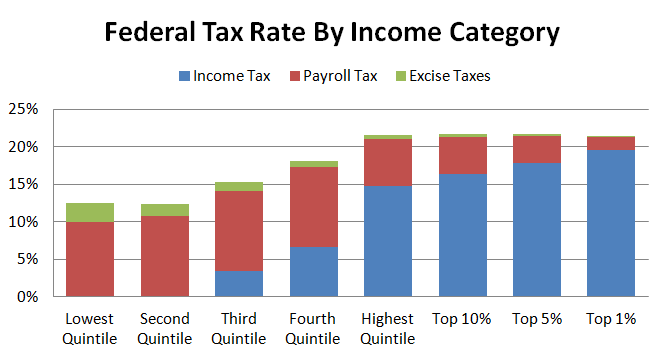
Here are the income tax rates, by income category, provided by the Congressional Budget Office:


Representative Bachmann is right. There are about 140 million Americans on the left side of the graph that aren't paying any taxes. But income taxes aren't the only federal taxes. Almost $900 billion in annual revenue is collected through payroll taxes on each and every paycheck. Another $75 billion is collected in excise taxes, such as those on gasoline. When we add these things in, things become a bit more equal.


However, it's clear that federal taxes still fall disproportionately on the top 20%.

Unfortunately, those aren't the only taxes we pay. More than 40% of our yearly tax bill goes to state and local governments, mostly in the form of sales and property taxes.


When we add together all taxes, we see that "the poor" (the bottom 20%) are the ones paying the highest tax rate.

Wow. This is hard to believe. But the more you think about it, the more it makes sense. The working poor spend the highest share of their income on basic necessities like housing and transportation. This is where property and sales taxes hit the hardest.

When I started researching this, I honestly thought that I would find out that the richest Americans were paying the highest tax rates. After all, we are constantly told that our tax system is progressive, meaning that tax rates rise as income levels rise.

As it turns out, the U.S. tax system isn't progressive. Of all the groups above, the top 1% actually have the 2nd lowest tax rate. The poorest Americans have a tax rate that is 38% higher than the rate paid by the richest Americans.

Wow.

So, the next time someone tells you that 47% of Americans don't pay any taxes, show them this graph:


Sources:
Historical Effective Tax Rates: 1979-2006. Congressional Budget Office.
Additional Data on Sources of Income and High-Income Households. Congressional Budget Office.